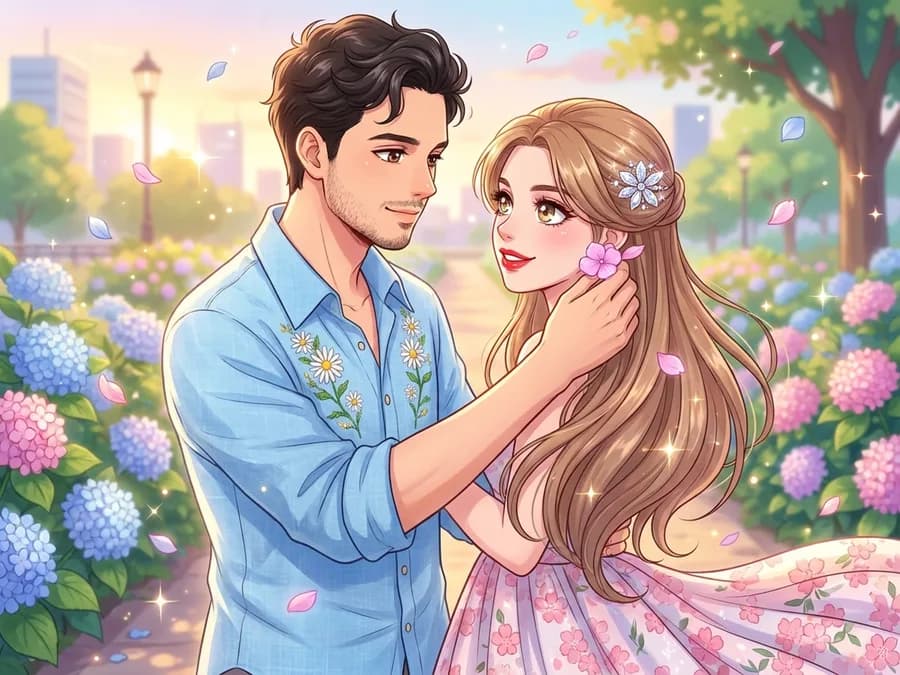
Search "personalized anime book" and most of what comes back is either a filter app that slaps an anime face onto your selfie for thirty seconds, or a commission artist with a six-week waitlist and a per-page rate that assumes you only want one picture. Neither one is a book. A filter gives you a single image with no story behind it. A commission gives you art without pacing, since one illustrator working alone rarely plans ten spreads as a narrative arc.
What people actually mean when they type that phrase is something in between: real photos of real people, turned into an anime-style story that has a beginning, a middle and an ending, bound as something you can hand to someone.
What a personalized anime book actually is
It is a hardcover storybook, 24 pages across 10 illustrated spreads, built around up to three people from photographs you send. The text and the artwork are generated with AI, then every single page goes through human review before you ever see it. You are not buying a filtered photo. You are buying a story, with your own cast.
The anime-shoujo style on Fableself leans toward romance drawn at full saturation: sparkling eyes, dramatic lighting, feelings that are not hidden anywhere. It suits a first-love story, a long friendship finally put into words, or a Valentine's book for someone who is well past their teenage years but still likes that register. It is sincere rather than ironic, and a giver who is a little embarrassed by sincerity should pick a different style.
The art style is not the whole decision. The story underneath it is what makes someone keep the book.
Getting the anime look right: what photos to send
This is the part people get wrong most often, and it is worth saying plainly: not every photo flatters this style equally.
The anime-shoujo treatment puts nearly all of its expression into the eyes. A wide candid shot taken from across a room loses most of what makes the style work, because there is no face close enough to read. What this style wants is close-ups, ideally with the person looking straight at the camera, where you can actually see the expression you are trying to capture.
A few things worth doing before you send photos in:
- Pick at least one clear, well-lit close-up per character, facing the camera.
- Skip sunglasses and anything shadowing the eyes in your main reference shot.
- Send a couple of photos per person rather than just one, from slightly different angles.
- If the story needs a specific place, include a photo of it. Backgrounds get drawn too.
One honest note before you commit: faces come out noticeably stylised, not photorealistic. Eyes get larger, features simplify, that is the anime tradition doing its job. If likeness matters more to you than that look, watercolour or pencil sketch will hold a face closer to how it actually looks.
Anime shoujo, studio ghibli, or manga: picking the right one
"Anime" covers more ground on Fableself than a single style, and it is worth knowing the difference before you choose, since each pulls the camera to a different distance.
Anime shoujo comes in close and draws the feeling on the face. It is built for a story where the emotion is the plot: first love, a confession, a friendship that outlasted a move across the country.
Studio Ghibli pulls back. It is the same broad tradition but told through landscape and atmosphere rather than a close-up expression, closer to a quiet countryside film than a romance panel. If the story is really about a place, a childhood house, a walk you took every summer, that one usually wins.
Manga, meanwhile, is monochrome and panelled, built for action and dialogue rather than painted color. A personalized anime book in the shoujo style and a manga-style book are not competing for the same story. Pick shoujo for romance and sentiment; pick manga if the plot has a plot.
Both the anime shoujo style page and the Ghibli page carry full sample art, so look before deciding rather than going on description alone.
The practical facts
- One edition: a 24-page hardcover, 10 illustrated spreads, up to three characters. There is no Petite, Standard or Deluxe tier to choose between, there is one book.
- You approve a full digital proof before any payment is taken. If something is off, it gets revised before you pay anything.
- A digital-only PDF is not sold. What you get is a printed hardcover, with the proof as a separate, earlier step.
- Photos are kept private, never used to train any model, and deleted after the book ships.
- Current pricing lives on the pricing page; a second copy of the same book, for a sibling or a parent, costs less than the original print.
Who actually orders this
The honest answer skews toward two groups. The first is younger readers and the anime-watching crowd generally, for whom the style itself is the appeal and the gift barely needs explaining. The second, which surprises people, is adults buying a Valentine's gift. The sincere, full-saturation register that feels slightly much in everyday life turns out to be exactly right once a year, which is why it is one of the recommended styles on the Valentine's gift page.
Either way, the brief matters more than the art. Three details to lock down before you order:
- The moment, not the relationship. "We've been dating two years" is a fact, not a scene. "The night we got stuck on the last train and missed our stop talking" is a scene, and scenes are what get illustrated.
- Who speaks. Shoujo stories usually work better from one character's point of view, written toward the other, rather than a flat third-person summary of both.
- One visual anchor. A place, an object, a specific outfit that shows up more than once. It gives the illustrator's reference something concrete to repeat across spreads, which is what makes a book feel like one story instead of ten disconnected pictures.
Ordering it
Once you have photos and a rough brief, the order page walks through character setup, style choice and the text brief, then puts together a proof for you to approve before anything is charged. A personalized anime book takes a few days for that proof, then printing and shipping on top, so building in a little slack before a birthday or an anniversary is worth doing rather than ordering the week of.
The whole point of the format is that it survives the thing filters cannot: a second, third, tenth reading. A filtered photo gets looked at once and forgotten. A story with a real cast, drawn properly across ten spreads, is the kind of thing that stays on a shelf.