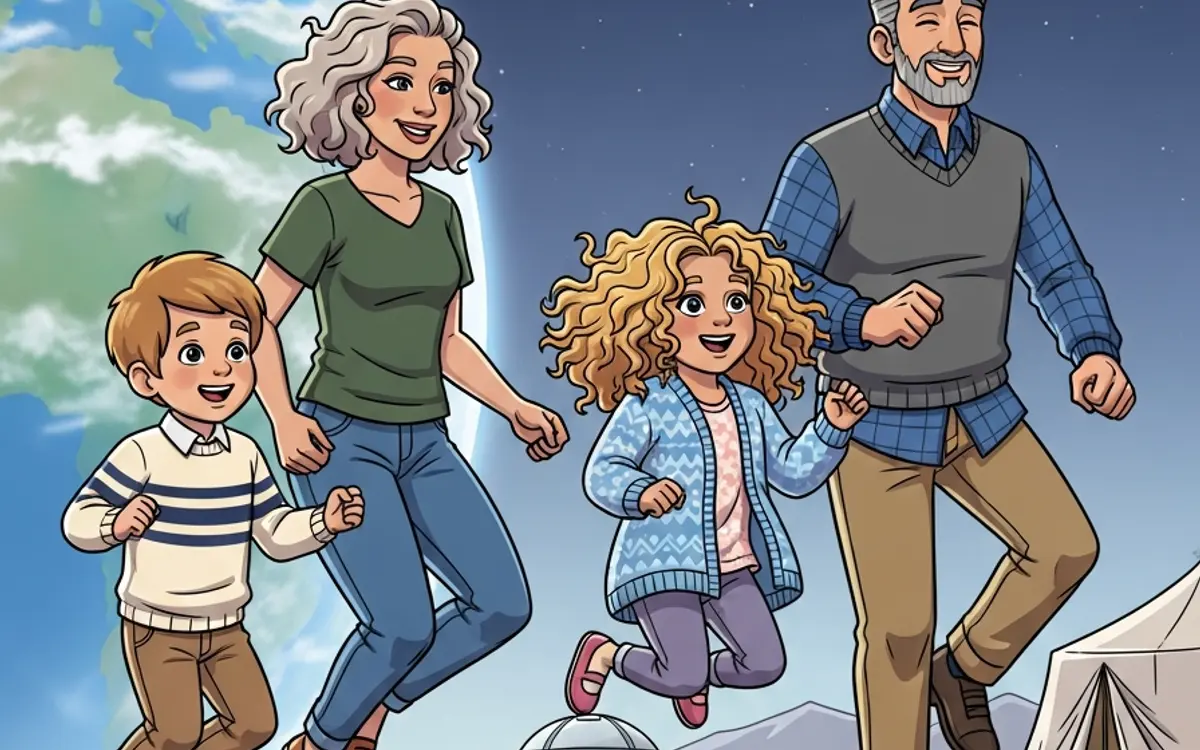
Type "custom comic book maker" into a search bar and you get two different products tangled together on the same results page. Half of them are apps: upload a photo, pick a filter, and a stylized panel comes back in a few seconds. The other half are services where a story gets written about specific people and turned into an actual printed book. These are not the same thing, and shopping for one while comparing prices on the other is how people end up unhappy with whichever they pick.
This is not an argument that one is better. It is a question of what you actually need, and the two answers point at genuinely different tools.
What a comic book maker app is actually good at
A maker app is, underneath the branding, a filter. You feed it a photo, it runs a style transform, and you get an image that looks like a comic panel. Some let you add speech bubbles. A few string three or four images into a short strip. What none of them do is write anything. There is no plot, no arc, no decision about what happens on page six because nothing has a page six. It is one image, or a handful of loosely connected ones.
That is a completely reasonable thing to want. If you need a stylized profile picture, a one-off image for a group chat, or you are just curious what you would look like drawn as a superhero, a maker app is the right tool and it is usually free or close to it. The output arrives instantly because there is nothing to compose.
Where it falls apart is the moment somebody wants to give it as a gift. A single filtered image, printed or not, does not read as a present. It reads as a novelty, and novelties get looked at once.
What commissioning a custom comic book actually means
Commissioning is a different category of product. Instead of running your photo through a filter, someone writes an actual short story with your people as the characters, and every page is illustrated to match that story rather than to match a template.
At Fableself, this comes as one edition: a 30-page hardcover with 13 illustrated spreads, built around up to six characters. The story and the artwork are generated with AI from the photos and the brief you send in, and then every single page is checked by a person before it ever reaches you. You see the whole thing as a digital proof and approve it before it goes to print. If a scene is off, it gets revised. Nothing gets printed until you say yes.
The comic book style itself sits alongside 23 other illustration styles, from watercolour to manga, so the comic look is a choice rather than the whole premise. You can see the panel-and-ink treatment on the comic book style page, including how it handles color, line weight, and the kind of scenes it suits best.
The real difference is structure, not polish
People assume the gap between a maker app and a commissioned book is quality, and it is not, really. Some maker filters look great. The actual gap is structure. A filter gives you a static image of a moment. A commissioned book gives you a beginning, a complication, and an ending, told across thirteen spreads with your actual person as the lead. One is a picture. The other is a story that happens to have pictures in it.
That distinction matters most at the moment you hand it over. A filtered image gets a quick laugh and a screenshot. A book gets opened from the front, read to the end, and put on a shelf where it gets pulled down again later.
Price and time, without the sales pitch
A maker app costs little to nothing because it is producing one image with no writing involved. That is fair; you are paying for compute, not craft.
A commissioned custom comic book costs more because a story has to be written and thirteen spreads have to be composed and reviewed by a person, not just generated and shipped. Current pricing is on the pricing page, and it is worth checking before you assume either option based on what a different kind of gift usually costs. A second copy of the same book, if you want one for another family member, is cheaper than the first since only the printing repeats.
Turnaround is also honest to compare. A maker app is instant. A commissioned book takes about 15 business days from order to door, proof, printing and shipping included. If there is a birthday or graduation on the calendar, that timeline is the thing to plan around, not the price.
When the app is the right call
Pick a maker app when you want something fast, low-stakes, and disposable in the good sense: a profile picture, a joke for a group chat, a way to see your dog drawn as a caped hero for thirty seconds of entertainment. There is nothing wrong with that use case. It is just not a gift, and it is not trying to be one.
When commissioning is the right call
Pick a commissioned book when the point is that someone specific gets to be the actual hero of an actual story, not a filtered photo of themselves. Graduations are a common trigger for this, since a comic book arc suits a "here is what you overcame" narrative better than almost any other style; the graduation gift page has more on that pairing. Birthdays for comic-obsessed kids or teenagers work the same way, and so does any moment where "here is a filter of you" would land flat but "here is a story where you're the lead" would not.
The order form walks through the brief, the photos, and the style choice in about the time it takes to fill out a longer online form, and the how it works page lays out every step between that form and the proof landing in your inbox.
The actual answer
There is no single correct custom comic book maker, because "maker" is doing two different jobs depending on who is asking. If you want an image, use an app; it is fast and it costs nothing. If you want a story with a real person as its character, printed as something that survives being opened more than once, that is a commission, not a filter, and it is worth treating as a separate decision rather than a fancier version of the same one.