
The structural problem with buying for fathers is that a lot of them have already bought the thing. Not out of greed. They just see a need, resolve it within the week, and move on. By the time a gift-giving occasion arrives, the obvious categories are covered: he has the drill, he has the whisky, he has more socks than a man can wear.
So the shopping collapses into novelty. Something with a joke printed on it. A gadget he will describe as "great" in a tone that means he is being kind.
A personalized Father's Day gift book sidesteps this by not being in a category he can pre-buy. Nobody can buy themselves a book about their own life.
Why the joke mug industry exists, and why it fails
Novelty gifts are popular because they solve the awkwardness rather than the problem. Fathers, in a lot of families, are not spoken to directly about how they are regarded. The joke gift is a way of expressing affection without having to say anything, and everyone understands the code.
The trouble is the code has a short shelf life. The mug is funny once. What it never becomes is a thing he keeps.
A book solves the same awkwardness differently. It says the direct thing, but on paper, so nobody has to make eye contact while it is happening. In practice this is why it works on men who deflect compliments. He can read it alone, later, and react however he likes with nobody watching.
The joke gift avoids the sentence. The book says the sentence and then leaves the room.
What to write about, and the trap to avoid
The trap is writing a tribute. "Thank you for everything you did for us" is true and it is not a story, and books built on gratitude alone come out flat.
Write about something you did together instead. Preferably something that went a bit wrong.
The books that land in this category are almost always about a small failure with a good outcome. The camping trip in the rain. The car that broke down twice. The DIY project that took eleven weeks and is still visible in the kitchen. The fishing where nothing was caught. Fathers are frequently at their most recognisable in the middle of an unsuccessful plan.
Send the specifics:
- The trip, project or routine that only the two of you would remember.
- What he says when something goes wrong, quoted exactly.
- One skill he has that you have never managed to learn properly.
- The place you picture him in when he is not there.
If there are grandchildren, a book about him as a grandfather is a different and also excellent option, and it tends to be the one that gets read aloud most.
The facts of what you are buying
- One edition: a 30-page hardcover with 13 illustrated spreads, up to six characters.
- The story and the artwork are AI-generated from your photos and your brief, then reviewed page by page by a person before you see a proof.
- You approve the full proof before anything is printed, and if it is not right it gets revised at the proof stage.
- Photographs are private, never used to train models, and deleted after the book ships.
- Details are on the pricing page, and a second copy of the same book costs less than the first.
That last point is practical for families where there are two father figures to think about, a dad and a father-in-law. Two different men need two different books, since the story is the whole product. But if two siblings each want a copy of the same book, only the printing repeats.
Picking a style he will not find twee
This is the occasion where art style does the most work, because the wrong style undermines the gift entirely. A book about a taciturn sixty-year-old rendered in soft pastel reads as a joke he did not agree to.
Cinematic concept art is the safest strong choice. It looks like a film still, it takes the subject seriously, and it suits stories set outdoors. Comic book style is the right call when the relationship runs on humour, and it makes a story about a failed DIY project genuinely funny rather than merely fond. Vintage engraving gives the book the weight of a heirloom and works well for grandfathers or for anyone whose story is set decades back. Retro mid-century is the one to pick for a man with taste, and it looks intentional on a shelf.
The full set is on the styles page, and the four above are collected on the Father's Day gift page.
Timing
Start at least three weeks before the day: about 15 business days from order to door, and a little room for one revision.
Late is survivable. Approve the proof, print it, hand that over on the day with a note, and let the hardcover follow. In this particular case the delayed version has an advantage: he opens the real book on a Tuesday when there is no audience, which is the condition under which most fathers actually read things properly.
When the relationship is complicated
Not every father is easy to write a book about, and a lot of the gift advice on the internet assumes otherwise.
If the relationship is strained, the honest version tends to work better than the warm one. A book about a specific good afternoon, with no claims made about anything else, is truthful and can be received without anyone having to renegotiate the whole history. Ambition is the enemy here. One afternoon is enough.
If he is gone, the book becomes a memorial rather than a present, and it is a different job with a different shape. There is a separate page for that: the memorial storybook.
The reaction to expect
He will read it in about four minutes, close it, and say "that's really good" in a flat voice.
Do not take this as a failure. Check the shelf in a month. That is where the actual verdict is.
Where to go next
Gift guide
A Father's Day Gift Beyond the Necktie →Styles that suit it

Cinematic
Epic light and painterly drama, your story told like a film's concept art.

Comic Book
Bold inked outlines, dynamic energy and halftone shading, graphic-novel heroics.
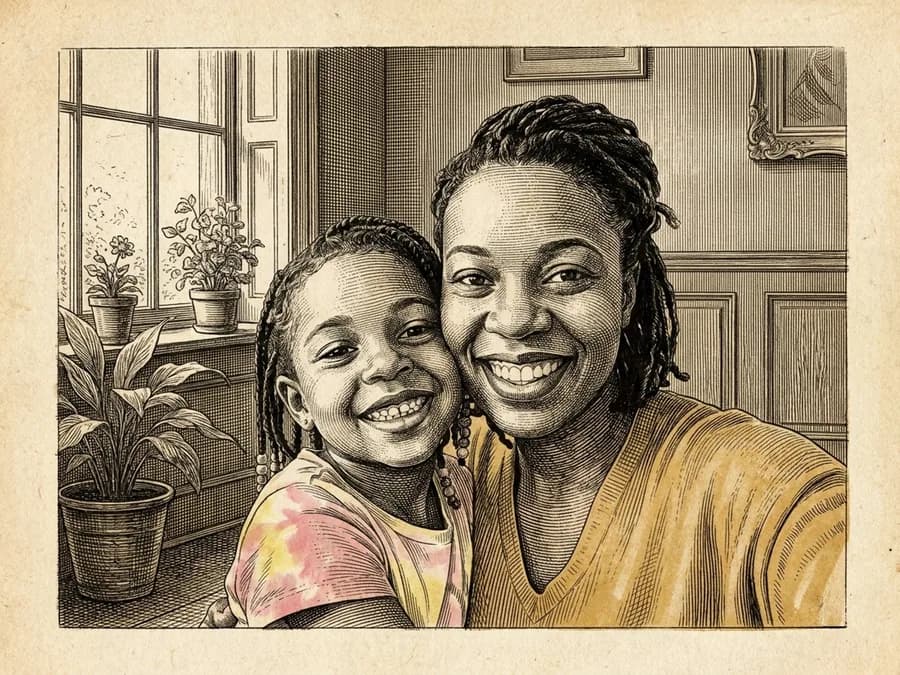
Vintage Engraving
Fine etched lines and sepia tones, like a treasured book from another century.